

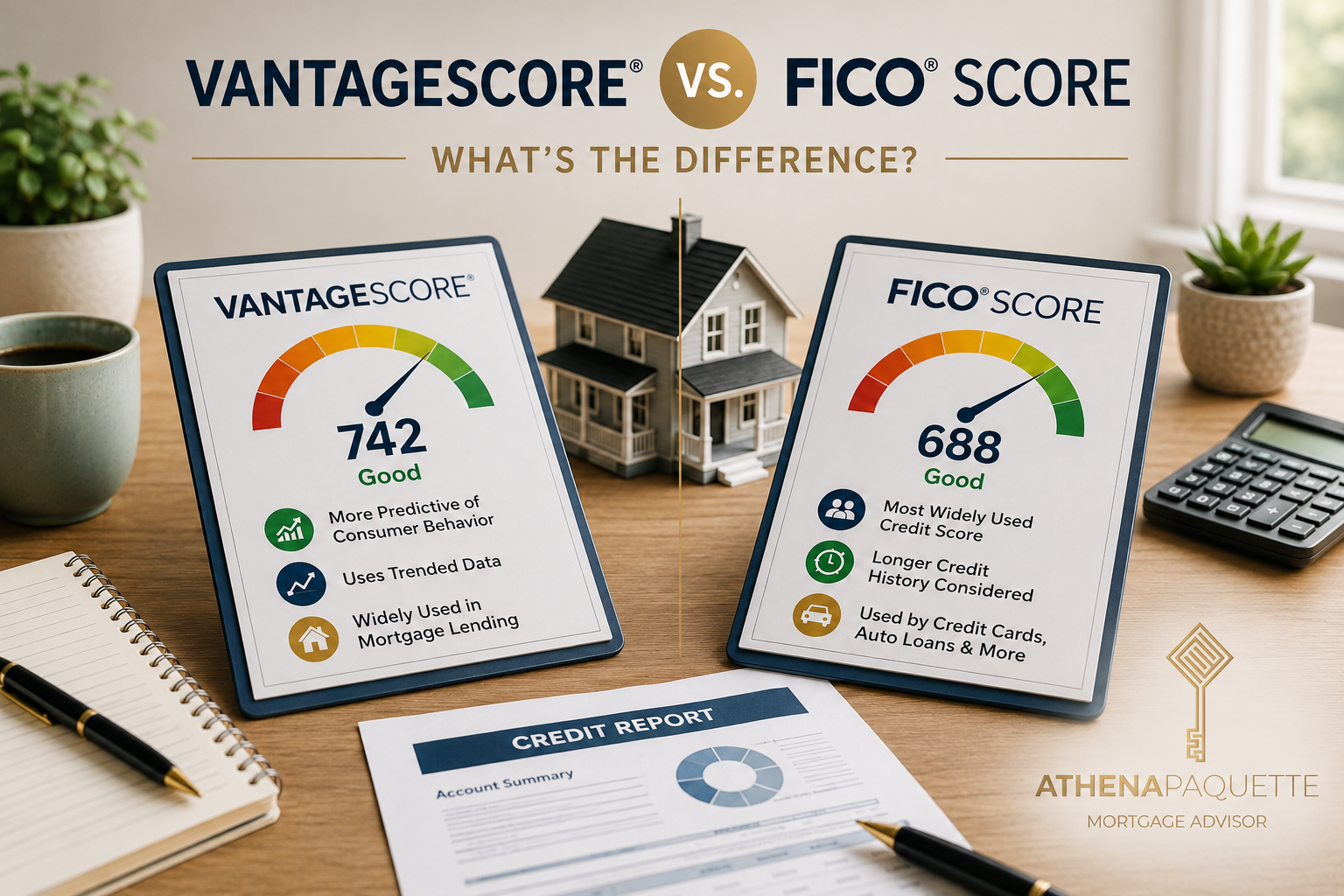

If you have ever checked your credit score and then had a lender tell you that your mortgage credit score is different, you may have wondered: Which score is correct?
The answer is: both scores can be correct.
This occurs because the consumer score you get may be different from the score a lender or car finance company pulls. Mortgage and auto lending scores can put different weight on aspects of your credit than the consumer-focused score you may see through a credit-monitoring service.
And besides your score being different from the one the lender pulls; a mortgage lender may also have multiple scores for you.
In practice, they pull all 3 credit bureaus‘ scores (TransUnion, Equifax and Experian) and use the middle of the 3. You on the other hand might have only checked Experian, which may be your highest score. And they can pull them on both scoring models. which means 6 scores.
The reason there could be 6 scores is that there is not just one credit-scoring model. VantageScore® and FICO® are different scoring models that analyze information in your credit reports and use that information to calculate a credit score. A score you see through a consumer credit-monitoring service may therefore be different from the score a mortgage lender uses.
What Is a Credit Score?
A credit score is a numerical representation of information in your credit history. It is designed to help lenders evaluate the likelihood that you will repay your debts.
But the number itself depends on the scoring model being used.
Think of it this way: Your credit report is the information being analyzed, while the scoring model is the formula used to analyze that information.
FICO® is one scoring company, and VantageScore® is another. Both use information from the major credit bureaus, but they use different models and may weigh information differently. That is why the same borrower can have different scores depending on which model is being used.
What Is VantageScore® 4.0?
VantageScore® 4.0 is a newer credit-scoring model developed by VantageScore® . It uses information from credit reports to evaluate a consumer’s creditworthiness and was designed to provide scores for a broader range of consumers, including people with shorter or limited credit histories.
This distinction can be particularly important when someone is trying to qualify for a mortgage.
Historically, mortgage lending has relied heavily on traditional FICO® credit scores. However, that is changing. In April 2026, Fannie Mae announced that VantageScore® 4.0 was being added as an approved credit-score model for eligible loans, alongside the existing FICO® options.
This helps borrower because VantageScore® looks at the trends, think of it like a moving story over time, more so than FICO® that is more like a single moment intime snapshot (you look good today but who knows what it looked like yesterday).
Why Can Your Scores Be So Different?
Consider a borrower who checks a credit score and sees a number that looks good but then applies for a mortgage and discovers that the lender’s score is considerably different.
This does not necessarily mean that anyone made a mistake.
Different scoring models can produce different results from the same underlying credit information. The models may consider factors differently, and some models are designed to evaluate consumers with limited or less traditional credit histories in ways that can produce a score when another model may not.
That can make a significant difference when someone is trying to qualify for a mortgage.
An Example From the Mortgage World
I recently worked with a buyer who had been approved for an FHA loan but found a condominium that was not FHA approved. Since the buyer wanted that particular property, we needed to look at a conventional financing option.
The borrower’s traditional FICO® scores were 623, 599, and 585. That created a problem because the conventional loan being considered required a minimum qualifying score of 620.
Instead of assuming the transaction was over, we looked at the borrower’s VantageScore® 4.0 results. The scores were 696, 696, and 675.
That difference changed the possibilities available to the borrower and allowed us to look at a conventional financing option without waiting for the condominium community to obtain FHA approval.
The Important Lesson
The important lesson is not that one scoring model is simply “good” and the other is “bad.”
It is that the score you see is dependent on the scoring model being used, and the model used for a mortgage can matter.
What Should Homebuyers Remember?
If you are preparing to buy a home, don’t assume that the credit score you see online is necessarily the same score a mortgage lender will use.
Your credit report, the scoring model, the type of loan, and the lender’s requirements can all affect the outcome.
Understanding the difference between a credit report, a credit score, and the different scoring models used to calculate that score can help you better understand your mortgage options and avoid surprises when you are ready to buy.
Want to know more about how VantageScore® saved the day? Watch Here (3:51).